Wealth & geography
The New Geography of Wealth
How to make better decisions when families, businesses and capital cross borders
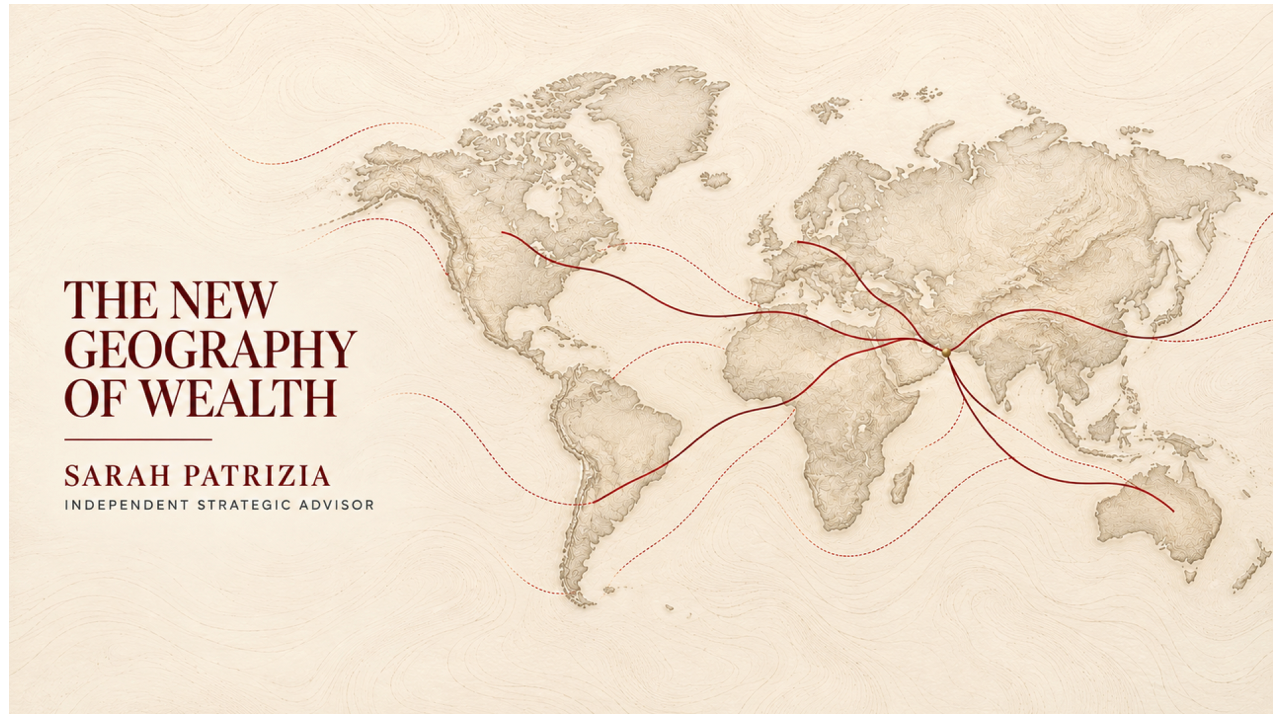
Wealth does not move as one
A family can live in one country, operate a business in another, hold investments across several markets and rely on advisers in still more. Calling all of this “relocation” or “international structuring” hides the decisions that matter: what is changing, why it is changing, and how the parts will continue to work together.
The practical question is not simply where wealth is going. It is which parts of a family’s life need to be in which places and whether each choice supports the family’s actual objectives.
| 88% | of family offices surveyed by UBS reported bankable assets in at least two jurisdictions. |
|---|---|
| 45% | of UBS-surveyed family offices involved the next generation to some extent. |
| 42% | of participating families’ portfolios in BlackRock’s 2025 survey were allocated to alternatives. |
The evidence points to coordination
UBS’s 2026 survey describes families spreading bankable assets across jurisdictions while facing geopolitical, regulatory and continuity risks. It also finds that next-generation involvement remains uneven: 45% of offices involve the next generation to some extent, while 52% of those where involvement is incomplete say they are looking to introduce education or training in future. That is intention, not completed preparation. [1]
The scale of the intergenerational shift is also material. UBS estimates that more than US$83 trillion in wealth will be transferred over the next 20 to 25 years. That forecast makes continuity and decision-making central to wealth planning not merely the location of assets. [3]
Four maps to examine before choosing a destination
A move can solve one problem and create another if the family treats these maps as though they were the same. I separate them first, then look at where they need to connect.
| The map | The decision to clarify |
|---|---|
| Residence | Where family members live, and what residency, tax, education and lifestyle needs sit behind that choice. |
| Enterprise | Where the operating business, customers, leadership, staff and future growth opportunities are located. |
| Capital | Where assets are held and invested, in which currencies, and under which legal and governance arrangements. |
| Advice and access | Where the family’s advisers, institutions, relationships and decision-making authority sit—and whose incentives shape the recommendation. |
The questions that improve the decision
Purpose What is the family trying to achieve: operating flexibility, a different lifestyle, education access, business expansion, portfolio diversification or continuity across generations?
Sequence Which decision must come first? A residence choice, company setup, property purchase and investment allocation have different dependencies and timelines.
Trade-offs What changes in tax exposure, legal obligations, liquidity, governance, access to talent and family relationships? Which benefits are real, and which depend on an assumption?
Incentives Who is recommending the destination, structure or asset? How are they paid, and what alternatives have they considered?
Reversibility If the family’s circumstances change, what can be unwound, at what cost, and what would be difficult to reverse?
Geographic diversification can reduce dependence on one location, but it does not automatically diversify investment risk. UBS’s report itself distinguishes regional concentration from asset-class concentration. The family still needs to understand what it owns, why it owns it and how the exposures behave together. [1]
A hub can help. It is not the strategy.
International financial centres and advisers can provide useful infrastructure, expertise and coordination. But adding a jurisdiction is not, by itself, a family objective. The right arrangement depends on what the family needs, what each location contributes and whether the advice remains accountable to the family rather than to the product or place being promoted.
Where my work begins
I advise European founders, investors, executives and internationally mobile families who are considering Dubai. My role is to bring clarity before a commitment is made: define the objective, test assumptions, understand the incentives around a recommendation and compare the realistic alternatives.
That can mean assessing whether Dubai fits a family’s wider plan; separating residence, business, property and capital decisions; evaluating a project or market proposition; or identifying the questions that should be answered before the family appoints advisers or signs documents.
I am not there to make every decision point to Dubai. I help clients decide whether Dubai belongs in their plan, what role it should play and what needs to be true for the move or investment to make sense.
Independent strategic advisory
My work is designed for the stage before a transaction, relocation or structure becomes difficult to reverse. Depending on the brief, an engagement may include a focused strategy session, market and project assessment, decision review or ongoing advisory support.
A useful starting point
Before choosing a market, adviser, property or structure, write down the decision in one sentence. Then list the objective, the alternatives, the assumptions and the person or institution that benefits if you proceed. If those answers are unclear, the next step is better analysis not a faster commitment.
If Dubai is under consideration, begin with the decision not the transaction. Contact me to discuss an independent strategy session or advisory brief.
Sarah Patrizia
Independent Strategic Advisor | Dubai and cross-border family decisions
Sources and scope
[1] UBS, Global Family Office Report 2026. Official source. Survey of 307 UBS client families across more than 30 markets, conducted 22 January–30 March 2026. UBS reports that 88% had bankable assets in two or more jurisdictions; 45% involved the next generation to some extent; and, among those where next-generation involvement was incomplete, 52% were looking to introduce education or training in future.
[2] BlackRock, 2025 Global Family Office Survey. Official source. Survey of 175 family offices in 27 markets, conducted 17 March–19 May 2025. Seven in ten had made or were planning changes to allocations; alternatives represented 42% of participating families’ portfolios.
[3] UBS, Global Wealth Report 2025. Official source. UBS forecasts more than US$83 trillion in total global wealth transfers over the next 20–25 years. The forecast is not limited to family-office assets.
All thought leadership